
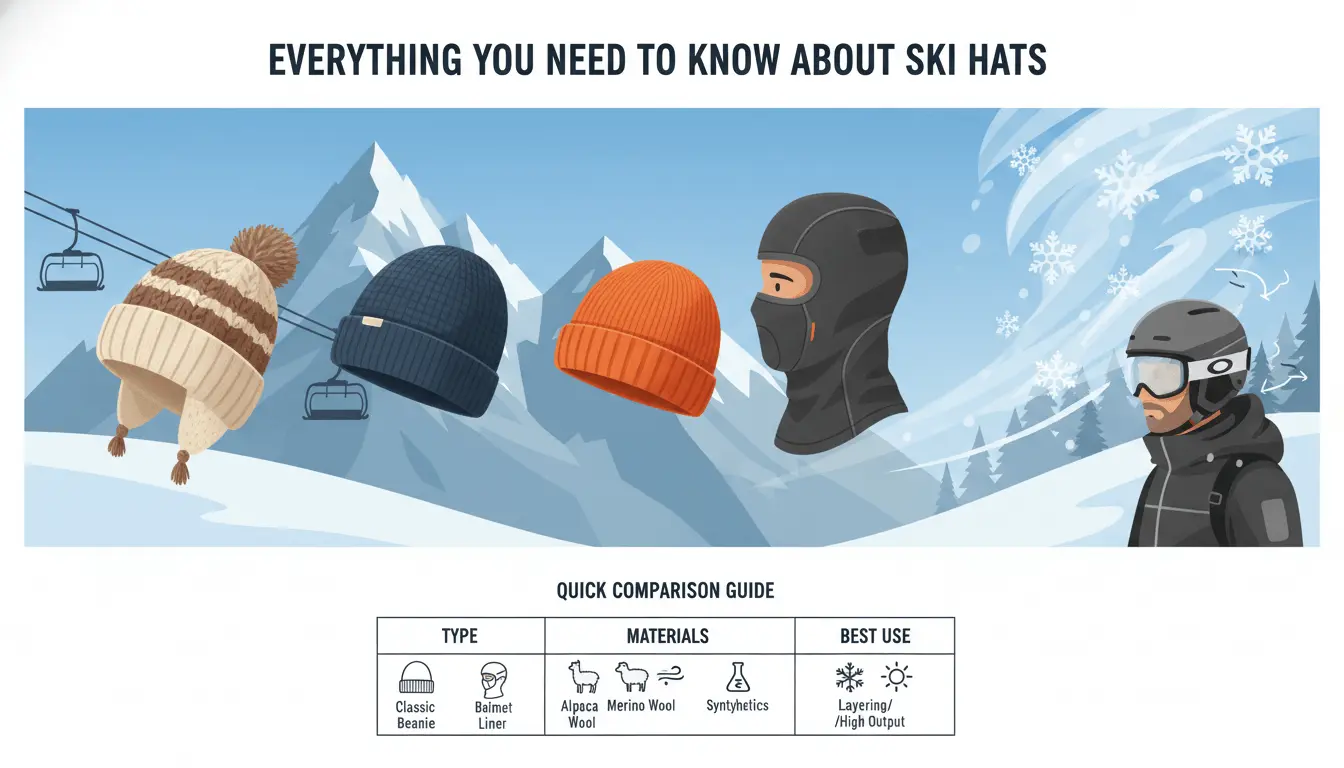
Quick comparison table - Ski Hats (types, materials, best use)
| Headwear type | Warmth | Breathability | Helmet fit | Wind | Best for |
|---|---|---|---|---|---|
| Thin knit ski beanie | Med | High | High | Low–Med | everyday “ski hat” use |
| Ski helmet liner / skull cap (merino/synthetic) | Low–Med | Highest | Highest | Low | hat under ski helmet, high-output laps |
| Fleece-lined beanie | High | Med | Low–Med | Med | cold mornings, lessons, slow skiing |
| Windproof beanie (ear panel/band) | High | Low–Med | Med | High | windy chairlifts, ridgelines |
| Thin ski balaclava | High | Med | Med–High | High | storms + face/neck coverage |
What are ski hats for and why should you find the perfect one?
If you ski in a helmet, the helmet already blocks wind and traps heat. Your beanie for skiing should mainly: (1) move sweat away from skin, (2) stay smooth under the shell, and (3) avoid pressure points that cause headaches or shift goggles. Thick cuffs, raised seams, and big pom-poms are the usual culprits. For most skiers, a thin ski helmet liner is the most reliable performance choice; add warmth outside the helmet with a hood or neck gaiter when you stop.
If you don’t wear a helmet, you can prioritize insulation and ear coverage—but moisture still matters. A hat that’s too warm for your effort level gets damp, then feels colder when you’re still on the next lift.
Analysis of all materials: Why do people prefer alpaca ski hats?
Alpaca Ski Hat: warmth without bulky weight
Alpaca is often described as having a (semi-)hollow fiber structure that traps insulating air, helping it feel warm without needing a thick, heavy knit. That’s ideal for chairlift comfort and for skiers who “run cold.” Alpaca fleece is also described as lanolin-free, which is one reason many people find alpaca hats less itchy than some sheep-wool hats. Some alpaca sources also emphasize moisture-wicking and warmth retention even with light dampness—useful when you sweat under layers and then sit still on the lift.
How to use alpaca best on-snow: treat an alpaca wool beanie as your cold-weather “outer hat” (lifts, breaks, après) or choose an alpaca blend in a tighter, lower-profile knit. Pure alpaca can be less elastic than merino, so blends can help keep the beanie snug through a season.
Merino wool beanies and liners: the sweat-management staple
Merino is a go-to for ski headwear because it performs well in the exact scenario that makes most people uncomfortable: high output on the descent, then stillness on the chairlift. When you’re skiing hard, your scalp produces heat and moisture fast. Merino helps you feel less “clammy” because it handles moisture in a way that supports comfort during stop-and-go activity. Instead of feeling like a wet plastic layer against your skin, a good merino liner tends to feel more stable across temperature swings, which is why it’s often the “daily driver” choice for resort laps.
Fleece & synthetics: fast-drying, easy performance
Synthetic liners (often polyester or poly blends) are popular for one reason: they dry fast. If you sweat heavily, a synthetic skull cap can shed moisture quickly once you slow down, which helps reduce that “I’m fine while moving but freezing on the lift” feeling. This is why many dedicated ski helmet liners are synthetic: they prioritize wicking and quick dry time over cozy, lounge-style warmth.
Fleece is the warmer sibling in the synthetic family. It traps heat efficiently, and it’s forgiving in cold morning conditions—especially if you’re standing in lift lines or coaching kids. The tradeoff is that fleece can become too much once your heart rate climbs. A fleece-lined beanie can feel perfect at first chair and then feel swampy after a few aggressive runs, because you’ve created a mini greenhouse under your helmet or goggles line. If you’re the type who unzips layers mid-run, you’ll probably want a thinner liner rather than full fleece insulation on your head.
If you’ve ever gotten “chairlift sting”—that sharp, painful cold on your ears and forehead—wind is usually the culprit, not the temperature alone. Windproof beanies and headbands solve this with wind-blocking panels (often around the ears/forehead), which can make a dramatic difference on exposed lifts and ridgelines. For resorts known for gusty mornings, this feature can feel like upgrading your entire kit, because it protects the most sensitive areas without forcing you into a bulky hat.
The compromise is ventilation. Any wind-blocking layer reduces airflow, so during high-output skiing it can trap heat and moisture faster than a normal knit or liner. That means windproof panels are best treated as a condition-specific tool: incredible when you’re cold and getting blasted on the lift, but potentially uncomfortable if you’re lapping bumps or hiking side hits all morning. Many skiers find the sweet spot is a windproof ear band (targeted protection) rather than a fully windproof hat that seals in too much heat.
All the details you need to know about hats skis
A ski hat can be made from premium fibers and still perform poorly if the construction doesn’t match how you actually ski. This is especially true with an alpaca ski hat: alpaca can feel impressively warm for its weight, but the build determines whether it blocks wind on the lift, stays put over your ears, and works as a ski hat under helmet without creating pressure points. When you’re choosing a ski beanie (or any beanie for skiing), focus on four construction details that directly control warmth, dryness, and comfort.
1) Knit density (gauge): wind protection vs breathability
Knit density is the most underrated factor in a ski hat. A denser knit reduces airflow through the fabric, which translates into better wind resistance on exposed chairlifts. A looser knit vents better and can feel more comfortable while you’re skiing hard, but it leaks heat faster when the wind picks up or temperatures drop.
For an alpaca ski beanie, density matters even more because you want warmth without excessive bulk. A medium-to-dense knit can deliver lift warmth without forcing you into a thick crown that fights your helmet fit. If you ski windy U.S. resorts, denser knit construction often beats going thicker, because extra thickness can trap sweat, then make you feel colder during the next slow lift ride.
2) Ear coverage: depth and stability beat “one size fits all”
Most ski hat discomfort starts at the ears. Many beanies look fine in the mirror but ride up the moment you tighten a helmet strap, adjust goggles, or start talking. A quick test: put the ski hat on, open your mouth wide, then turn your head side to side. If the hem climbs and your ears pop out, the hat is too shallow or the shape doesn’t match your head.
Look for a ski beanie with a deeper cut (more vertical coverage), a hem that stays stable (doesn’t curl or relax after a few wears), and stretch that rebounds after being pulled on and off. With an alpaca ski hat, also pay attention to structure and recovery: alpaca can be less springy than some wools, so the best alpaca ski hats often use rib structure and/or a small performance blend to keep ear coverage consistent through a full day.
3) Seams and interior finish: helmet comfort is built from the inside
If you wear a helmet, seams can make or break your day. Thick crown seams and bulky interior stitching create pressure points that become headaches after 20–30 minutes. A premium-looking ski beanie that causes pressure is worse than a basic liner that disappears under your helmet.
For a ski hat under helmet, prioritize flat seams or minimal-seam construction, a smooth interior at the crown and forehead, and no thick cuff bunching under the helmet rim. If you’re deciding between an alpaca ski beanie and a merino or synthetic liner for on-snow performance, use seam comfort as the tiebreaker. The hat that feels invisible under your helmet usually keeps you warmer long-term because you won’t constantly adjust it or loosen your helmet to relieve pressure.
4) Goggle interface: avoid gaps, drafts, and fog triggers
A ski hat shouldn’t change how your goggles fit. Too much fabric at the brow (often from a thick cuff, heavy ribbing, or layered knit) can push goggles slightly forward and create drafts. That tiny gap can also contribute to fogging because airflow and warmth around the top of the goggle frame changes.
Do a quick at-home check: put on the ski hat, then helmet, then goggles. Check for a clean contact line between helmet brim and goggle frame. Move your jaw and eyebrows; if the hat bunches upward and nudges the goggles, go thinner or choose a smoother brow knit. For an alpaca ski hat, this often means choosing a low-profile crown and avoiding an oversized cuff if you plan to wear it under a helmet. Many skiers keep an alpaca ski hat as the lift and break beanie and use a thin liner while skiing hard, which preserves goggle seal and reduces sweat buildup without giving up alpaca warmth when you’re stationary.
Protective gear combinations for use in the mountains while skiing
Resort skiing in the U.S. is stop-and-go: you heat up on descents, then cool fast on long, windy chairlifts. That’s why the most reliable approach is simple: use a thin layer that works as a ski hat under helmet while you’re moving, and keep a warmer ski beanie for cold lift rides, breaks, and après. An alpaca ski hat fits best as that warm layer because alpaca warmth is most noticeable when you’re not generating heat.
Cold + windy (exposed chairlifts, ridgelines)
Use a thin helmet liner as your ski hat under helmet to keep sweat off your skin. Add a neck gaiter for lift rides if wind is biting your face. For warmth during pauses, pull on an alpaca ski beanie or alpaca ski hat—alpaca helps you feel warmer quickly without needing a bulky crown. If you run hot, keep the alpaca ski hat for lifts and breaks rather than skiing hard in it.
Cold + dry Rockies (big morning-to-afternoon swings)
Start with a merino or synthetic liner for skiing, especially if you wear a helmet. It’s warm enough while moving and helps avoid that “sweaty hat becomes cold hat” problem later. Keep an alpaca ski hat as your backup warmth: put it on for first chair, long lift rides, or when you’re standing around. If you don’t wear a helmet, an alpaca ski beanie can be your main ski hat on cold mornings, but swap to a thinner beanie for skiing if you start overheating.
Wet snow (PNW storms, coastal humidity)
Prioritize quick-drying layers. A thin liner is usually the safest ski hat under helmet in wet conditions because it dries faster than thicker knits. Pack a spare liner so you can change if the first gets damp. Use your alpaca ski hat as a warm break/after-ski beanie unless you’re sure your alpaca knit dries well overnight—starting day two with a damp ski beanie is the fastest way to feel cold.
The simple two-piece system
For most skiers, the best combo is: a thin liner for active skiing, plus a warmer ski beanie for pauses. This is an easy way to stay dry and warm without compromising helmet fit. After skiing, air-dry your ski hat (and alpaca ski hat) fully—don’t leave it balled up in a bag—so the next morning starts warm instead of clammy